netoptim package
Submodules
netoptim.network_oracle module
- netoptim.network_oracle.Cut
A cutting plane represented as a tuple of (gradient, intercept).
The gradient is typically a vector representing the subgradient of the objective function, and the intercept is the constant term in the linear cut.
- netoptim.network_oracle.Graph
A directed graph represented as an adjacency dictionary.
The outer dict maps each node to a dict of its neighbors. Each neighbor maps to either a dict of edge attributes (e.g., {‘w’: weight}) or a tuple of (source, target) edge information.
alias of
Dict[Any,Dict[Any,Dict[str,Any] |Tuple[Any,Any]]]
- class netoptim.network_oracle.NetworkOracle(gra: Dict[Any, Dict[Any, Dict[str, Any] | Tuple[Any, Any]]], u: Dict[Any, int], oracle: Any)[source]
Bases:
objectOracle for Parametric Network Problem:
The NetworkOracle class represents an oracle for solving a parametric network problem, where the goal is to find values for variables x and u that satisfy certain constraints.
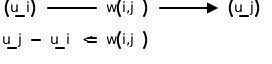 find x, us.t. u[j] − u[i] ≤ oracle(edge, x)∀ edge(i, j) ∈ E
Examples
>>> from unittest.mock import Mock
>>> gra = {
...     "v1": {"v2": {"w": 3}, "v3": {"w": 4}},
...     "v2": {"v1": {"w": -2}, "v3": {"w": 1}},
...     "v3": {"v1": {"w": -3}, "v2": {"w": -2}},
... }
>>> u = {"v1": 0, "v2": 0, "v3": 0}
>>> oracle = Mock()
>>> oracle.eval.side_effect = lambda e, x: e["w"] - x
>>> oracle.grad.side_effect = lambda e, x: -1
>>> network = NetworkOracle(gra, u, oracle)
>>> network.assess_feas(1)
(2, 3)
- assess_feas(x: Any) Tuple[Any, float] | None[source]
Assess feasibility and generate a cutting plane if infeasible.
This method implements the feasibility oracle for the parametric network problem. It searches for negative cycles in the graph using Howard’s algorithm. If a negative cycle exists, it returns a cutting plane (gradient, intercept) to cut off the infeasible point.
- Parameters:
x – The current iterate value to assess for feasibility.
- Returns:
A Cut tuple (gradient, intercept) if the point is infeasible (negative cycle exists), or None if feasible.
netoptim.optscaling_oracle module
- netoptim.optscaling_oracle.Arr
A NumPy array type alias for array operations in the optimization.
- netoptim.optscaling_oracle.Cut
A cutting plane represented as a tuple of (gradient array, intercept).
The gradient is a NumPy array representing the subgradient, and the intercept is a scalar constant term.
- class netoptim.optscaling_oracle.OptScalingOracle(gra: Any, utx: Any, get_cost: Any)[source]
Bases:
OracleOptim[ndarray]Oracle for Optimal Matrix Scaling
This example is taken from[Orlin and Rothblum, 1985]
 min π/ψs.t. ψ ≤ u[i] *
|a_ij|* u[j]^{−1} ≤ π,∀ (i,j) ∈ E,π, ψ, utx, positive- class Ratio(gra: Any, get_cost: Any)[source]
Bases:
objectInner class for computing ratio constraints in matrix scaling.
This class evaluates the constraint ψ ≤ u[i] * |a_ij| * u[j]^{-1} ≤ π by computing the minimum of two differences in logarithmic scale.
- eval(edge: Any, x: ndarray) float[source]
Evaluate the ratio constraint for an edge.
Computes min(π - a_ji, a_ij - ψ) where x = (π, ψ) in log scale. A positive result indicates the constraint is satisfied.
- Parameters:
edge – The edge (i, j) to evaluate.
x – The current iterate (π, ψ) in logarithmic scale.
- Returns:
The minimum of the two ratio differences.
- grad(edge: Any, x: ndarray) ndarray[source]
Compute the subgradient of the ratio constraint.
Returns a subgradient vector indicating which bound is active: - [1.0, 0.0] if the upper bound (π) is active - [0.0, -1.0] if the lower bound (ψ) is active
- Parameters:
edge – The edge (i, j) to evaluate.
x – The current iterate (π, ψ) in logarithmic scale.
- Returns:
A 2-element NumPy array representing the subgradient.
- assess_optim(xc: ndarray, gamma: float) Tuple[Tuple[ndarray, float], float | None][source]
Assess optimality and return a cutting plane if suboptimal.
Implements the oracle interface required by
cutting_plane_optim(). First checks feasibility via the network oracle; if feasible, checks whether the current objective value can be improved.- Parameters:
xc – The current iterate (π, ψ) in logarithmic scale.
gamma – The best-so-far optimal value.
- Returns:
A tuple
(cut, value)wherecutis a(gradient, intercept)pair andvalueis either the objective value (if optimal) orNone(if a cutting plane was generated).
Examples
>>> from mywheel.map_adapter import MapAdapter
>>> gra = MapAdapter([{}, {0: (1.0, 1.0)}])
>>> utx = [0.0, 0.0]
>>> def get_cost(edge):
...     return 1.0, 1.0
>>> oracle = OptScalingOracle(gra, utx, get_cost)
>>> x = np.array([0.0, 0.0])
>>> t = 0.0
>>> cut, t1 = oracle.assess_optim(x, t)
>>> cut[0]
array([ 1., -1.])
>>> cut[1]
0.0
>>> import numpy as np
>>> bool(np.isclose(t1, 0.0))
True
>>> x = np.array([1.0, 0.0])
>>> t = 0.0
>>> cut, t1 = oracle.assess_optim(x, t)
>>> cut[0]
array([ 1., -1.])
See also
cutting_plane_optim
Module contents
Network Flow Optimization Package.
Provides tools for solving parametric network flow problems using cutting-plane methods and ellipsoid algorithms.